
Nobody Was Getting Better
Karen Dion, LAC, NBC-HWC — Director of Coaching and Senior Advisor, Oar Health

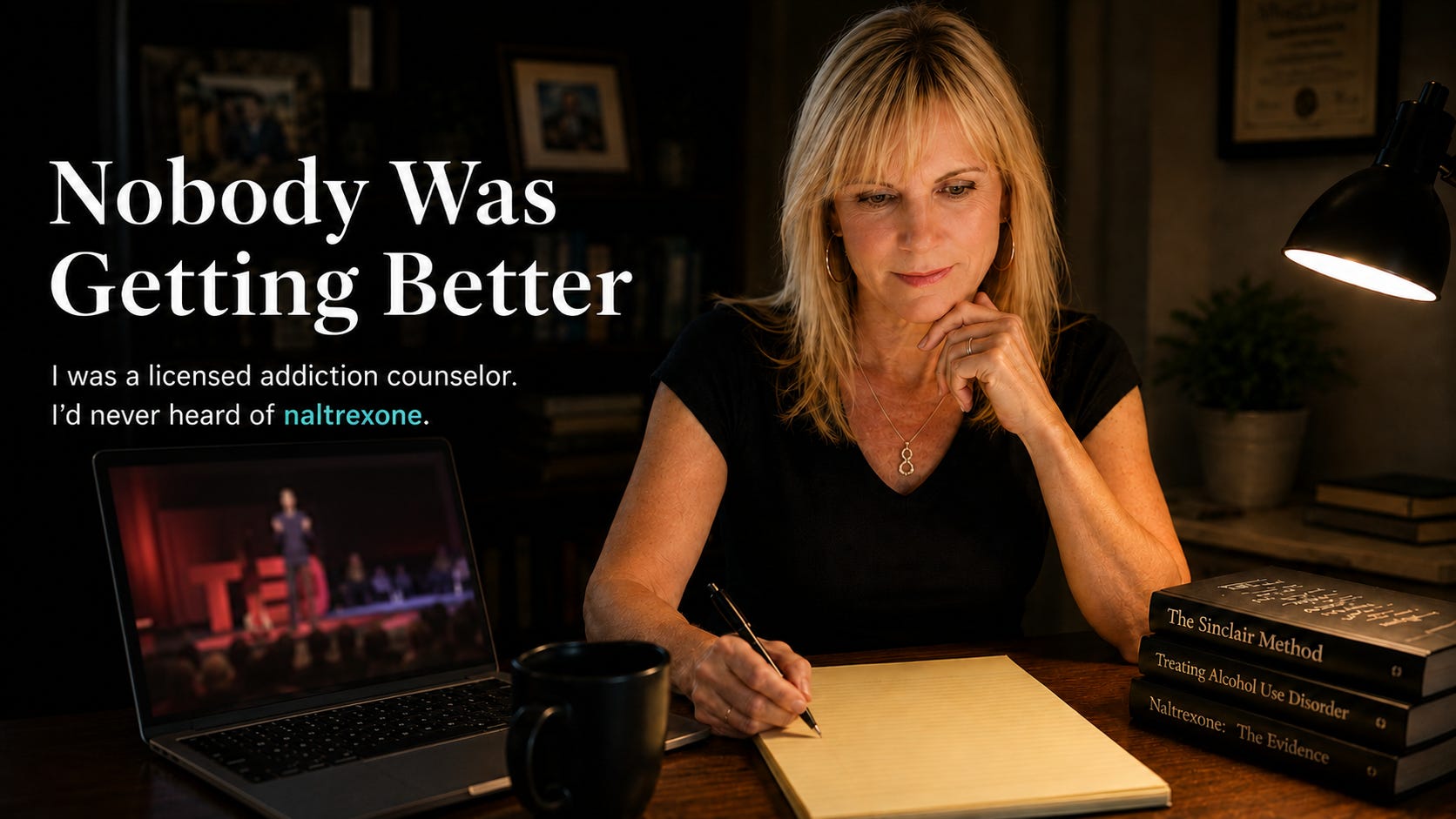
In the summer of 2017, I was sitting in my office at the hospital, searching for a way to help a client who wasn’t making progress with cutting back on her drinking.
I worked as a Health and Wellness Coach in the preventive health department of our regional medical center, helping people make sustainable changes in their eating, tobacco use, stress, and alcohol use. I came to coaching after leaving the addiction counseling field, having watched too many clients cycle through the same system and leave no better than they arrived. Coaching had been the antidote to that. It focused on what people could do rather than what they had failed to do. It worked. Mostly.
But alcohol was different. I had a client who was doing everything right and still couldn’t get traction. She wanted to change. She was doing the work. But every week, she came back having lost ground over the weekend, frustrated and ashamed in equal measure. I had nothing new to offer her. So I went looking, and that search led me to a TEDx talk by an actress named Claudia Christian.
I watched Claudia, confident, articulate, and successful, describe twenty years of struggling with alcohol and her discovery of a medication called naltrexone. And when the video ended, I sat very still. What she was describing should not have been possible: a medication that reduces your desire to drink, gives you back your off-switch, and doesn’t demand complete abstinence.
I was a licensed addiction counselor. I had years of post-graduate clinical training specifically focused on alcohol and substance use. And I had never, not once, heard anyone mention this medication.
If it worked, I thought, why was it a secret? It had been FDA-approved for decades. Why was I just hearing about it now? And if a pill could quiet the craving, what else had I been getting wrong?
I had completed a year of clinical training as an addiction counselor inside a chemical dependency clinic, and I already knew part of the answer to that question.
The clients at the clinic where I did my internship were mostly court-ordered, there for alcohol-related offenses. The majority didn’t want to be there, and I couldn’t blame them. The program they were required to complete included intensive outpatient treatment, individual counseling, mandatory AA attendance, and a strict order to abstain from alcohol. Many were tested regularly.
The ones who wanted to change often couldn’t maintain abstinence despite doing everything they were told. Their cravings were simply too overwhelming. The ones who didn’t want to change were playing the game, following requirements without buying into the treatment. Either way, nobody was getting better. Some had been through those same doors multiple times.
The facility matched the program: stained carpets, beat-up furniture, a building that had given up on itself. The counselors on staff were technically sober but visibly struggling, chain-smoking, overworked, underpaid, bringing their own chaos into a room already full of it. I finished my internship year with the uncomfortable conviction that what I was witnessing wasn’t treatment. It was forced compliance, not recovery.
I left the field.
Not long after, I attended a seminar where I met a mentor who introduced me to an emerging profession I hadn’t heard of, health and wellness coaching. It was the polar opposite of what I had witnessed in the clinic, client-centered rather than punitive, built on strengths rather than shame, flexible rather than rigid. He encouraged me to apply for a coaching position at the regional hospital, and I got the job. I trained with Wellcoaches and earned board certification from the National Board for Health and Wellness Coaching, in the first cohort to sit for that exam. The credential mattered because it meant something specific: a structured clinical framework, not just good instincts and a willingness to listen.
The behavioral tools I learned worked well for most of my clients. But there were always a few, the ones struggling with alcohol, for whom the tools weren’t enough. I could help them track, plan, reflect, and recommit. What I couldn’t do was silence the noise in their heads.
I had that problem too, as it turned out.
To be clear, I didn’t meet the clinical criteria for alcohol use disorder. My drinking wasn’t escalating. It wasn’t costing me relationships or my career. But as I got older, I noticed that even a couple of glasses of wine interrupted my sleep, and I found myself thinking about alcohol on days I didn’t drink. I applied everything I knew as a coach: tracking, goal-setting, supplements that claimed to reduce cravings, and adding healthy habits to crowd out the less healthy ones. After three years of real effort, I had meaningfully reduced my drinking. I was down to a few glasses of wine a few evenings a week.
And yet it was exhausting. Even after three years, it wasn’t getting easier. I had to work hard every single time to stay within my own guidelines. What I kept thinking was: if only there were something that could remove my desire for alcohol, everything else would follow naturally.
All of that changed the day I stumbled upon Claudia’s TEDx talk. Her drinking was far more serious than mine, but what she described stopped me cold: a medication that extinguishes the desire to drink rather than demanding you override it. That was exactly what I had been looking for.
Because my doctor was a colleague I regularly ran into at professional events, I wasn’t ready to have that conversation. So, I obtained it outside the traditional clinic setting. While I waited for it to arrive, I read everything I could find about naltrexone and The Sinclair Method, the protocol developed by researcher David Sinclair, which instructs patients to take naltrexone one to two hours before every drinking episode.
The mechanism is elegant and counterintuitive: by blocking the opioid receptors that generate the reward from alcohol, the medication gradually weakens the compulsion to drink. You don’t quit first and hope for the best. You take the medication before drinking, and over time, the craving simply loses its grip.
The medication arrived. I followed the protocol precisely, taking it before drinking and tracking everything.
After about three months, something shifted. I still remember the moment I noticed it, the absence of something that had been there for a long time. The mental chatter about alcohol was simply gone. I decided to take a full break from alcohol for a month and see what happened. I had tried dry January and sober October before, with considerable effort and limited success. This was different.
There was no struggle, no white knuckling, no mental negotiation. Just peace.
In three months, naltrexone had done what three years of disciplined behavioral work had not.
That experience changed my professional life as much as my personal one.
I started cautiously suggesting naltrexone to clients at the hospital who were struggling with alcohol. Right away, I noticed the prescription alone was not enough.
Clients needed to know where to find a doctor willing to prescribe it, which proved harder than it should have been. When side effects hit in the first few weeks, they needed reassurance that the nausea or fatigue would pass. Many were ambivalent about taking a medication at all, unsure whether their drinking was serious enough to warrant a pill, worried about what it would mean socially, and uncertain how they would handle stress without alcohol as a release. These weren’t clinical crises. They were the ordinary doubts and practical questions that come with starting a treatment most people had never heard of, one that asked them to rethink everything they believed about how recovery worked. But there was nobody to answer them.
I started providing that support informally through my coaching and online groups, then formally through a partnership with sinclairmethod.org, a web-based program that helps people access naltrexone. What I noticed quickly was that the support people needed wasn’t complicated. The same questions kept coming up. The same turning points, the same moments of doubt, the same relief when it started working. I was having the same conversations hundreds of times, one person at a time. That pattern was the signal: this could be a program.
In 2022, I approached another naltrexone advocate, Katie Lain, about building something more scalable. Together, we created what became Thrive, a peer-support program centered on naltrexone and The Sinclair Method. It gave people the framework, the community, the step-by-step guidance. It worked.
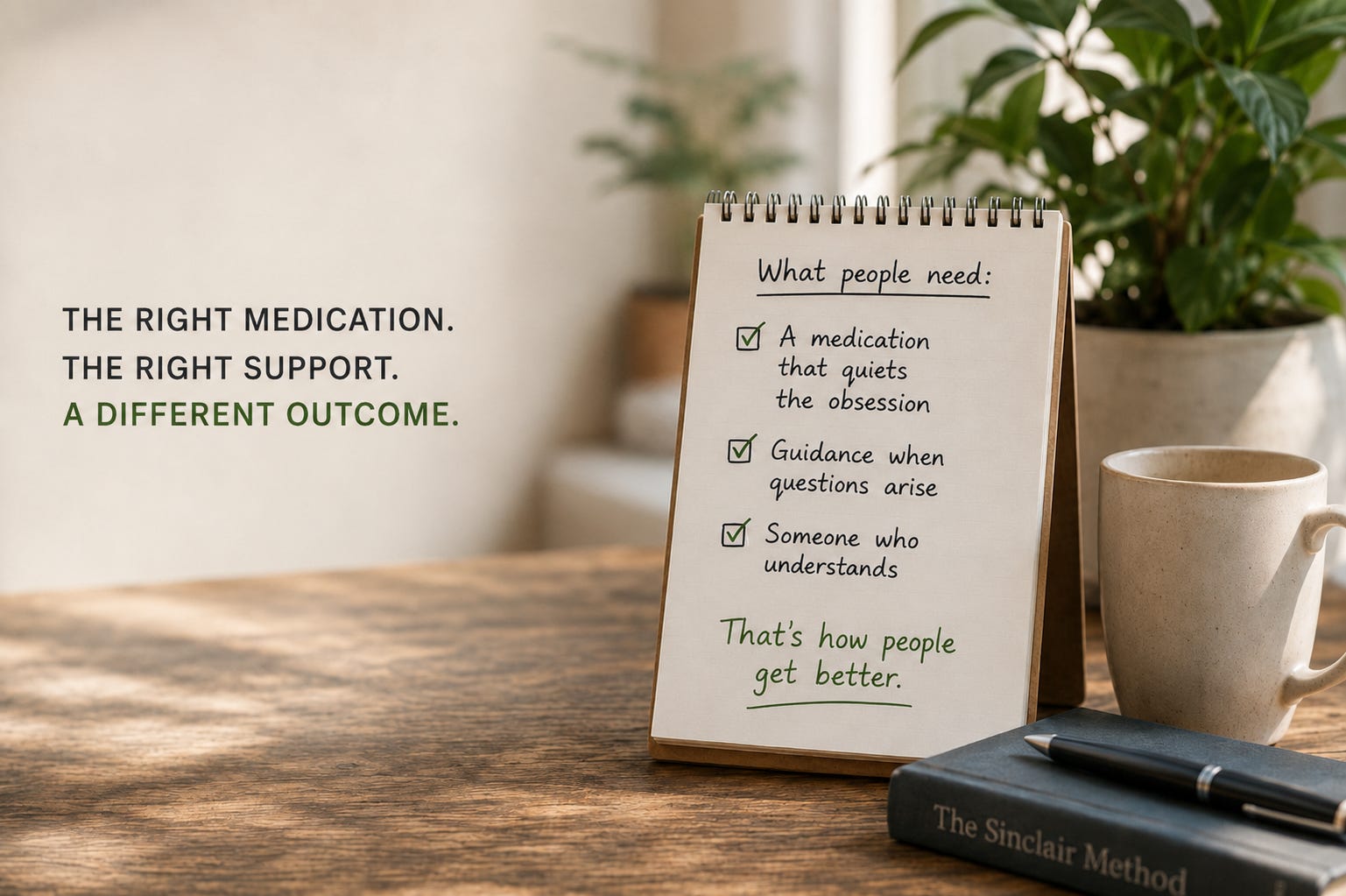
Peer support gave people something the medical system never did: the credibility of shared experience. But experience is not a clinical framework. When someone was struggling with side effects or worried that naltrexone wasn’t working, what they needed wasn’t just someone who had been through it. They needed someone who could recognize where they were in the process, ask the right questions, and tell them with confidence that what they were feeling was normal and what to do next. That’s a trained skill. It takes the same human contact that makes peer support work and adds the clinical structure that makes it reliable for thousands of people with different histories, drinking patterns, and definitions of success.
But the longer I helped those who were still struggling despite taking naltrexone, the more I felt the pull toward something more clinically structured.
So about two years ago, I left Thrive and joined Oar Health, a telemedicine company that focuses on making naltrexone accessible to people who might never walk into a doctor’s office to ask for it. But medication alone, I knew, was only part of the picture. The behavioral side of treatment mattered too. The questions, the uncertainty, the moments of doubt that came up week after week. There was no coaching model in place when I arrived. Creating one became my primary focus.
What I developed is built around a simple insight: people starting naltrexone don’t need a weekly appointment. They need someone available when the questions actually arise. At ten at night, when a side effect hits. On a Sunday morning, when they’re not sure whether to take the medication before a family dinner. The model works through secure messaging. Members write when something comes up, and a trained coach responds, usually within a day. No scheduling, no waiting rooms, no folding chairs in a church basement. Just a knowledgeable, professional coach available when you need one.
The coach draws on a clinical framework specific to naltrexone treatment: early side effects, questions about timing and dosing, moments of discouragement, and the gradual recognition that it is working. Because the support fits discreetly into daily life rather than pulling people out of it, it reaches people a traditional clinical model never would.
One woman I worked with had been drinking at least a bottle of wine a day for more than thirty years. Her doctors had warned her repeatedly that alcohol was making her diabetes worse, but every attempt to cut back ended the same way: a return to drinking, sometimes more than before.
She heard about naltrexone through a television ad and ordered it online. When it arrived, she almost threw it away. Was her drinking really serious enough to need medication? Maybe she could try to cut down one more time on her own. Then came a night at a party where she drank far too much, embarrassed herself in front of people she cared about, and woke up the next morning knowing something had to change.
She took the first dose the next day. Within an hour, she felt nauseated and was convinced the medication wasn’t for her. That’s when she reached out to me. I explained that nausea is one of the most common early side effects and that it almost always subsides as the body adjusts. We talked through some strategies, and she decided to give it another week.
She wrote back about a month later. The nausea was long gone, and something had shifted. She was drinking roughly half of what she had been, with less compulsion and more control than she had felt in years. She was full of hope, and ended her message with something I have never forgotten:
“If I hadn’t been able to reach someone that first day, I would have thrown the bottle away and never known what true freedom from alcohol felt like.”
That one exchange has stayed with me.
Getting the prescription is only the first step. What keeps people going, especially in those early weeks when giving up feels most tempting, is knowing there is a trained professional who understands what they are going through and can help them through it.
About a year ago, we added a second coach at Oar. Between us, we have now directly supported more than seventeen thousand members.
Seventeen thousand people who got support for their alcohol use. People who would never have walked into a treatment facility, who live in places where treatment options barely exist, who had tried and failed before and weren’t willing to try again in the traditional way. The asynchronous model removed the barriers that stop people from starting: the stigma of sitting in a waiting room, geographic isolation, and cost.
I often think about that clinic where I trained. The stained carpets. The clients cycling through the same doors. The counselors who meant well but were working with the only tool they had been given.
What the system offered those people was abstinence or nothing. What many needed was a medication that could quiet the neurological noise driving their drinking, paired with behavioral support that met them where they actually were. The medication had existed for decades, sitting on shelves, largely unprescribed. The coaching tools existed, too. But nobody had put them together in a meaningful way, and people kept failing, returning, and failing again.
I came to naltrexone as a skeptic with years of post-graduate clinical training and every reason to dismiss it. It changed my drinking, my understanding of what treatment could look like, and what I did with the rest of my working life.
The addiction treatment establishment didn’t do this. The grassroots did. Former drinkers posting in Facebook groups at midnight. Advocates like Claudia Christian took the stage to share what mainstream medicine had kept quiet for decades. Individuals who found their own way to naltrexone shared what was working and refused to stay silent about it.
I am not someone who sought a platform. I didn’t take the stage the way Claudia did, and I didn’t build a public profile around my own recovery. What I did was less visible than that. I answered messages at ten at night. I helped people through the first hard weeks. And over time, those conversations became a system — one that has now supported thousands of people finding their way through naltrexone treatment.
Seventeen thousand people got their off-switch back.
That’s enough for me.
Karen Dion, LAC, NBC-HWC, is Director of Coaching and Senior Advisor at Oar Health, where she developed the organization’s asynchronous coaching model for alcohol use disorder. She is co-founder of the Naltrexone Alliance (naltrexonealliance.org).
Editor’s Note (JRV)
Karen Dion found naltrexone the way many people still do: by accident, while looking for help. She was a licensed addiction counselor and board-certified coach, but what sets her story apart is that she recognized naltrexone’s potential when the medical system was largely looking the other way. She helped build the coaching infrastructure now supporting tens of thousands of Oar Health people. Not every breakthrough comes from the top down.
I should note that I serve as Senior Adviser at Oar Health alongside Karen, and that Steve Wagner and I are her co-founders at the Naltrexone Alliance.
 | A guest post by
|
Excellent testimonial. Thank you for sharing.
Thank you Dr. V. Your entries, including Karen's contribution, paint the picture of a smoldering emergence of what hopefully will become a large movement!